
2026 China (Zhejiang)–Brazil University Presidents Dialogue Held at ZISU
The 2026 China (Zhejiang)–Brazil University Presidents Dialogue was held at Zhejiang International Studies University (ZISU) on November 17. Under the themed "Digital Intelligence Empowering Industry–Education Integration: Jointly Writing a New Chapter in China–Brazil Cooperation," the event built a higher-education dialogue platform between Zhejiang and Brazil to enhance mutual understanding, promote practical cooperation, and jointly open new prospects for China–Brazil higher education cooperation, while injecting educational momentum into the China–Brazil comprehensive strategic partnership.
The dialogue was guided by the Embassy of the People's Republic of China in the Federative Republic of Brazil, the Center for Language Education and Cooperation of the Ministry of Education of China, and the Zhejiang Provincial Department of Education. It was jointly hosted by the Zhejiang Association for International Exchange of Education and the Brazilian Association of Presidents of Federal Higher Education Institutions, and organized by Zhejiang International Studies University, Zhejiang A&F University, and Beihang University.
In her address, Zhang Huanzhou, Party Secretary of Zhejiang International Studies University, proposed three cooperation initiatives: strengthening people-to-people bonds to consolidate the foundation of China–Brazil friendship; harnessing digital intelligence to innovate models for jointly cultivating talent; and orienting cooperation toward industry to deepen practical industry–education integration. She expressed the hope that universities in China and Brazil would jointly build a digital teaching-resources platform and, focusing on key cooperation areas such as cross-border e-commerce, digital trade, and advanced manufacturing, establish a school–enterprise collaborative education community. She added that the outcomes of educational cooperation should be translated into tangible benefits for industrial development, so that industry–education integration can help improve and upgrade China–Brazil economic and trade cooperation and serve the common development of both countries.
Shu Peidong, Deputy Director of the Zhejiang Provincial Department of Education, said that higher education is a key vehicle for aligning the two countries' development strategies and unlocking cooperation potential. He noted that Zhejiang is promoting an in-depth role for higher education in serving the modern industrial system through a "universities + platforms + enterprises + industrial chains" pairing mechanism, while Brazilian universities have distinctive strengths in areas such as agricultural science and biomedicine. He expressed the hope that university presidents from both sides would take the dialogue as an opportunity to expand the depth and breadth of higher education cooperation and further enhance mutual understanding and friendship between China and Brazil.
[Photo by Zhao Zhenyu]
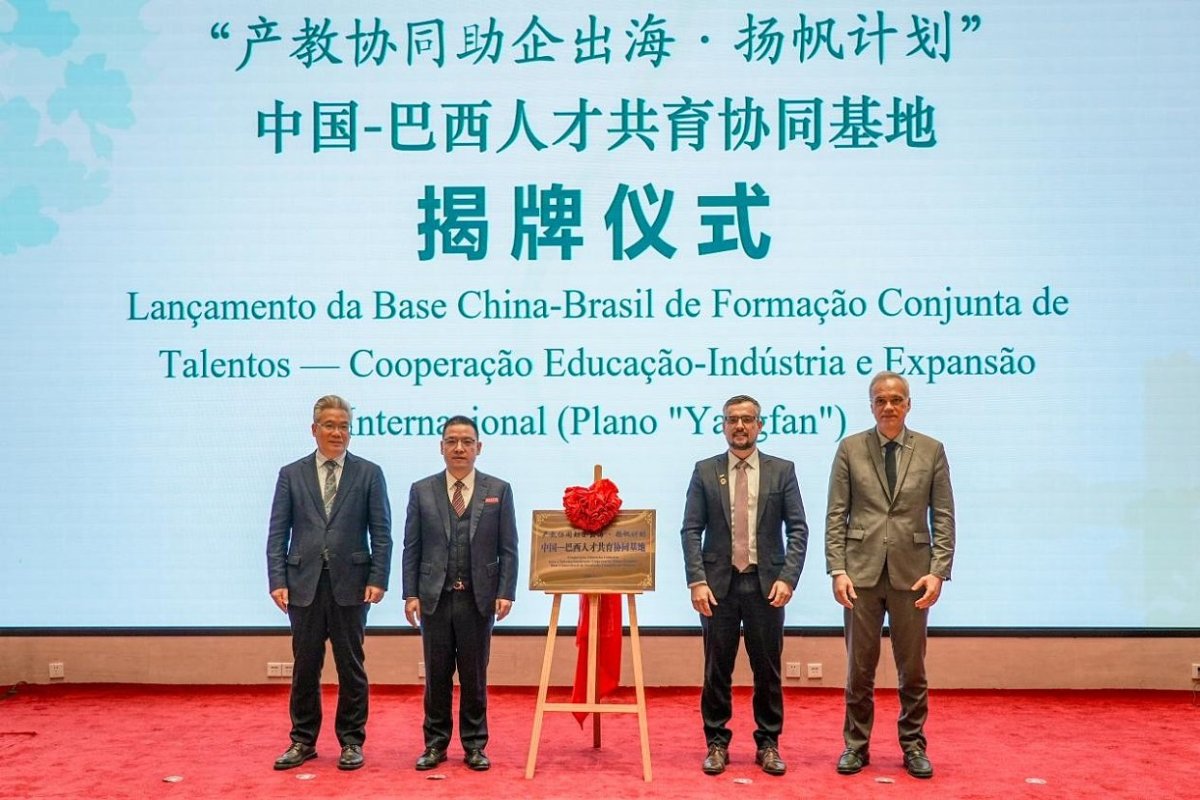
The Zhejiang Association for International Exchange of Education and the Brazilian Association of Presidents of Federal Higher Education Institutions signed a memorandum of understanding. The "China (Zhejiang)–Brazil University Industry–Education Integration Consortium" and the China–Brazil Talent Co-cultivation Collaborative Base under the "Sailing Plan" for industry–education collaboration to help enterprises go global were unveiled at the event. Four invited guests delivered keynote reports from the perspectives of technology, universities, enterprises, and mechanisms, discussing new pathways for China–Brazil educational cooperation.
The dialogue featured three roundtable sessions, where university presidents, experts, scholars, and representatives from enterprises and think tanks from China and Brazil exchanged views on "Technological Innovation and Sustainable Development," "Civilizational Mutual Learning and School–Enterprise Collaborative Cultivation of International Talent," and "Life-Science Innovation and Global Health Governance." Consensus statements were released after each roundtable session.
As 2026 marks the China–Brazil Year of Culture, the event served as an important starting point for industry–education coordination and joint talent cultivation in higher education between Zhejiang and Brazil. Going forward, Zhejiang universities will actively participate in building long-term cooperation mechanisms and advance multi-level and wide-ranging exchanges and cooperation with Brazilian universities in talent cultivation, joint research, and industry–education collaboration. (By Tian Tian and Zheng Zhouxuan)
(Source: Zhejiang International Studies University)


- Tel:+86-010-68891122
Copyright ©1997- by CRI Online All rights reserved
