
beijing
On March 30, Bao Qin, a 46-year-old line worker at the Diaocha Power Supply Station of State Grid Hanchuan Power Supply Company, set out on a line inspection route through Diaocha Lake Wetland Park with a tool bag on her back. This marks the 23rd year she has been safeguarding the power lines of Diaocha Lake. Over the past 23 years, she has witnessed the largest inland freshwater lake on the Jianghan Plain transform from a fish farming area once dense with ponds and crisscrossed by overhead lines into the ecological wetland park it is today, lush with vegetation and where tens of thousands of birds gather.
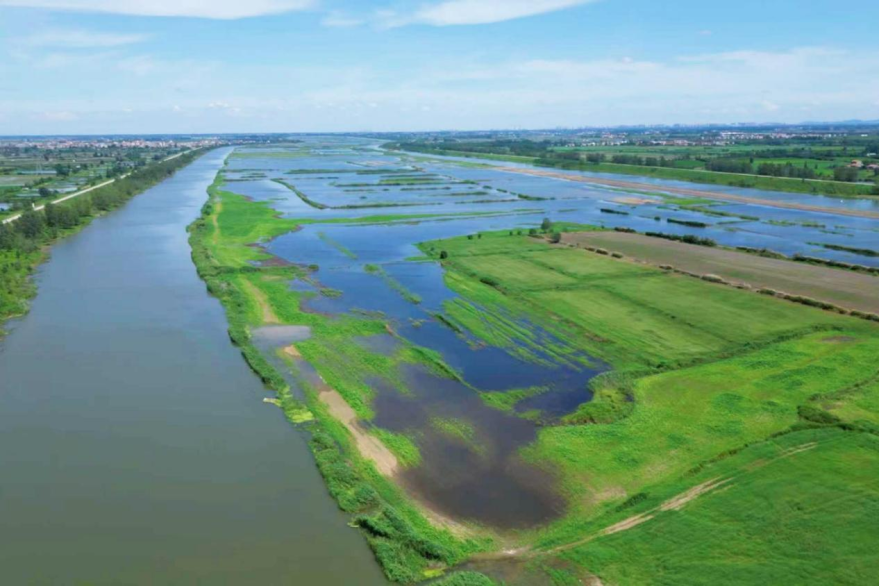
Diaocha Lake National Wetland Park
Photo by He Yao
Over two decades ago, the shores of Diaocha Lake were lined with more than 2,000 fish ponds operated by aquaculture households, with field ridges crisscrossing the area. 10 kV overhead lines extended across the sky, and utility poles stood between the ponds and the ridges. In 2017, lakeside villages such as Bayi Village carried out a program to return reclaimed farmland to the lake and ecological relocation in an orderly manner. More than 2,000 households gave up aquaculture, moved ashore, and were resettled elsewhere.
After the villages were relocated, part of a 10 kV branch line around Diaocha Lake, which had been erected years earlier to support production and daily living, still crossed the core waters of the lake. State Grid Hanchuan Power Supply Company has advanced the underground cable installation project in phases and completed the first phase of the renovation project for Diaocha Lake Wetland Park in September 2025, removing a total of 77 utility poles and 12 kilometers of conductors and newly laying 3,057 meters of underground cable. This has eliminated line safety hazards and further enhanced the neatness and beauty of the ecological landscape, while the second phase of the renovation project is progressing steadily.
Today, Diaocha Lake has truly become the "Pearl of the Jianghan Plain." Its water quality consistently meets the Class III surface water standard, submerged plants sway beneath the surface, and 142 bird species inhabit the area each year. Every autumn and winter, nearly 100,000 migratory birds arrive here. The healthy ecosystem has boosted tourism, with waterfront platforms and birdwatching towers built in succession, attracting large numbers of tourists and photography enthusiasts each year. (By Du Yuan, He Yao, Jing Xi, Wang Shiqi)


Copyright ©1997- by CRI Online All rights reserved
