
beijing
Recently, employees of State Grid Gannan Power Supply Company used a live-line work robot to install grounding and testing rings on the 10kV Chengzhong Line in Hezuo City, Gansu Province. This is the first deployment of live-line work robots on distribution networks in Gansu's high-altitude areas and marks a new phase of intelligent and automated live-line operations on distribution networks.
At the live-line operation site of the 10kV Chengzhong Line in Hezuo City, at 2,980 meters above sea level, an insulated bucket truck smoothly delivered the live-line work robot to the work point, following the operator’s remote commands. The robot flexibly extended its arm and accurately completed a sequence of standardized tasks—conductor identification, insulation stripping, and installation of grounding and testing rings—without interrupting the power supply to local residents. The operation was safe, efficient, and orderly.

Live-line robot in action
Gannan Tibetan Autonomous Prefecture in Gansu Province is located on the eastern edge of the Qinghai-Tibet Plateau, with distribution lines mainly at 2,000–3,700 meters elevation, which makes line operation and maintenance (O&M) challenging. In traditional manual live-line work, operators tire quickly from high-altitude hypoxia, and bulky insulating gear becomes less maneuverable in low-temperature conditions, increasing the hazards of working at height. The primary aim of installing grounding and testing rings is to enhance line safety protection, secure maintenance operations, and further optimize regional power supply reliability, thereby ensuring safe and reliable electricity supply for the public.
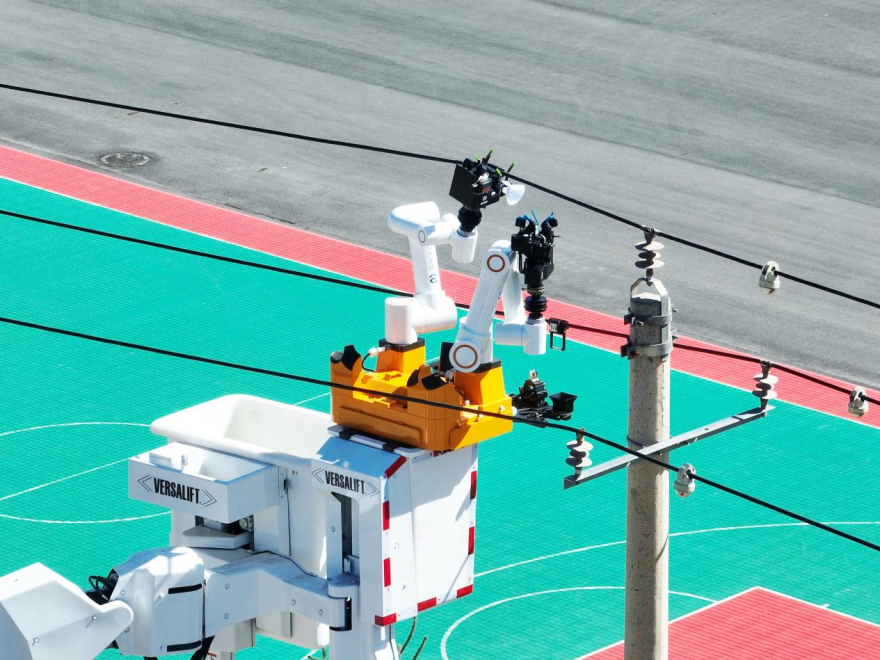
The robot's arm performs precise operations
Relying on its flexible arm, high-definition visual recognition system, and precise positioning technology, the live-line work robot methodically completed a series of standardized tasks, including conductor securing, insulation stripping, ring alignment, bolt tightening, precise handling of socket wrenches, and installation of grounding and testing rings.
Compared with traditional manual live-line work, robot operations eliminate the need for personnel to work near energized equipment in bulky insulating gear. Operators can complete the entire process from a safe area on the ground using a handheld remote control to operate the bucket truck and robot, thereby eliminating risks such as falls from height and electric shock at the source. Robot operations enhance efficiency by approximately 55% compared to manual methods, significantly reducing workers' physical burden while ensuring continuous and stable distribution-line operations—demonstrating the greater safety, reliability and efficiency that high-tech equipment brings to distribution network O&M.
As the company's first practical attempt of intelligent live-line work on distribution networks, this operation has not only improved distribution line safety protection and filled a technological gap in intelligent live-line operations, but also verified the robot's operational stability and safety at around 3,000 meters in low-temperature conditions. It clarifies operational procedures and safety control specifications for robot operations, providing a replicable model and practical reference for deploying live-line work robots in other high-altitude areas of the province.
Next, State Grid Gannan Power Supply Company will promote live-line work robots across counties and cities within the prefecture, driving the shift from manual-dominated live-line work to human-machine collaboration led by intelligent systems. This will further advance intelligent distribution network O&M and provide solid technical support for building a high-efficiency, reliable, intelligent, and low-carbon new power system. (Text/Photo by Wang Yanan and Zhang Haifei)


Copyright ©1997- by CRI Online All rights reserved
