
beijing
On September 19, a briefing on the interim findings of an archaeological survey of pre-Qin settlements in the Boluo area of the Dongjiang River basin was held in Boluo County, Huizhou. One site was mentioned repeatedly at the meeting: the Luoyang Site.
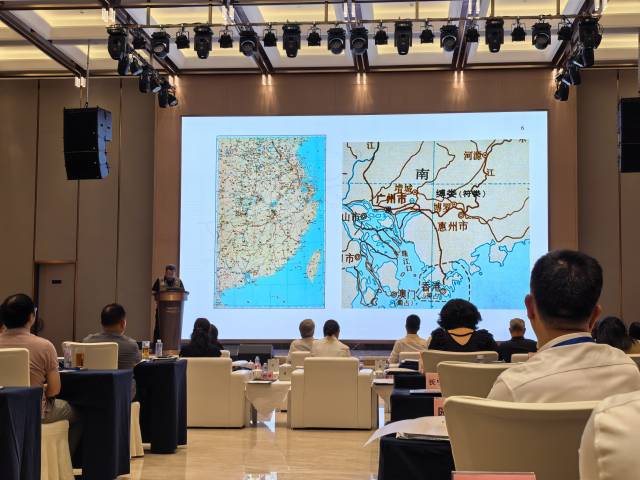
The Luoyang Site was discovered by chance. “At first, there was almost nothing visible on the surface—only a few pottery sherds,” said Zhang Qianglu, director and research fellow at the Guangzhou Municipal Institute of Cultural Heritage and Archaeology, who has visited Boluo four times. “Another team might have given up, but they dug down two metres.”
Two metres below the surface were the remains of a settlement dating to the Warring States Period. The archaeological team sought not only to determine whether a pre-Qin settlement had existed at the site, but also to establish its form and reconstruct the society of the time.
For the archaeologists, the pottery sherds are the most reliable evidence currently available. Pre-Qin settlement remains in Lingnan are often scattered and displaced as a result of long-term soil erosion, later disturbances and modern development—a phenomenon Li Bo describes as “low archaeological visibility”. At the outset of the survey, the team therefore decided to adopt a chaîne opératoire approach to pottery, examining everything from vessel forms and decorative patterns to production techniques. By tracing subtle changes, the archaeologists could determine the site’s chronology, cultural traditions and relationships with other settlements.
Scientific dating has confirmed that the settlement was continuously inhabited from the late Spring and Autumn Period to the late Warring States Period. In the same area, the team also uncovered a wealth of settlement features dating to the Warring States Period, including building foundations, wells, postholes and ash pits, along with flat and semi-cylindrical roof tiles and large quantities of pottery. With its deep, largely undisturbed stratigraphy and continuous chronological sequence, the Luoyang Site is expected to provide Lingnan’s first reference stratigraphic sequence for the Warring States Period.
Current evidence indicates that Lingnan during the Spring and Autumn and Warring States periods was not an isolated “wild frontier” cut off from the Central Plains. “The architectural components and construction techniques show parallels with those found in areas north of the Nanling Mountains. Some pottery also points to cross-regional exchanges, with certain features particularly comparable to those found in Zhejiang,” said Li Bo.
(Written by Xu Antong)


Copyright ©1997- by CRI Online All rights reserved
