
beijing
Recently, State Grid Gansu Electric Power Company replaced a single insulator on the Gansu section of the ±1,100-kV Changji–Guquan ultra-high-voltage direct current (UHVDC) transmission line in Shandan County, Zhangye. The company described the operation as China's first live-line replacement of a single insulator on a line at this voltage level and an internationally advanced achievement, filling a technical gap in China's live-line maintenance of high-voltage UHVDC lines.
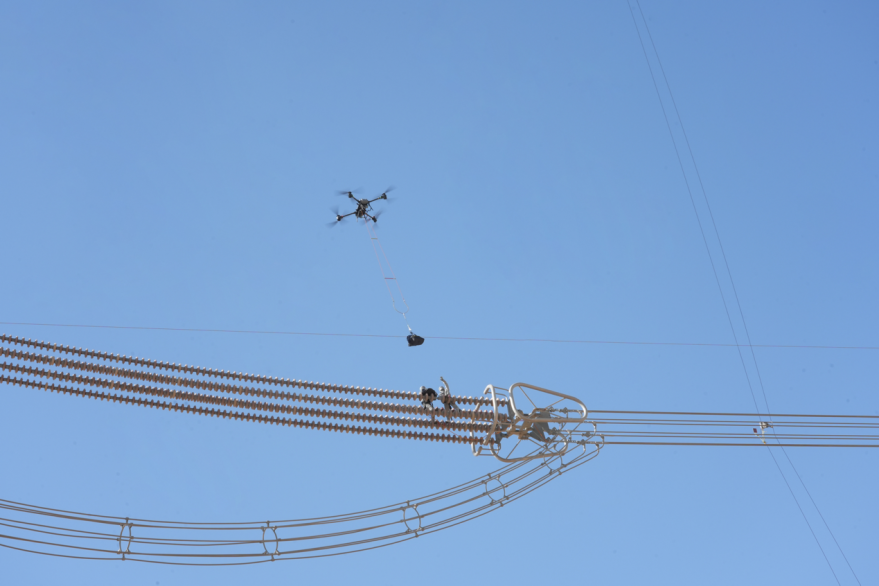
Live-line insulator replacement on the Gansu section of the ±1,100-kV Changji–Guquan line
The work was completed in 90 minutes without interrupting power transmission, compared with about 12 hours for conventional maintenance requiring an outage. This reduced the work time by 87.5%. The ±1,100-kV Changji–Guquan line is a key UHVDC route for transmitting electricity from Xinjiang. It extends 3,304.7 kilometers, including 1,279.6 kilometers in Gansu. An outage on the line could create a power shortfall of 6 million to 8 million kilowatts in eastern China and affect the region's electricity supply.
The operation carried significant risks because of the strong electric field around the UHV line and the weight of the single insulator, which was 20 kilograms. State Grid Gansu Electric Power Company coordinated the work, while its Gansu Ultra-High Voltage Company assembled a specialist team. The team used mechanized equipment and intelligent monitoring to manage safety risks.
Before the operation, the team used point-cloud data to build 3D models of the transmission towers and simulate the work, then refined its safety procedures. At the site, it installed environmental monitoring equipment and combined on-site personnel supervision with intelligent sensing to keep risks under control throughout the operation.
According to Li Wei, the person in charge of the operation, the mechanized and intelligent methods reduced risks to personnel working at height. The company said the operation marked another advance in UHVDC maintenance following its completion of what it described as the world's first live-line defect repair on a ±1,100-kV UHV line in 2020. It further developed techniques for live-line UHVDC maintenance and supported the allocation of electricity resources nationwide. (Text and photos by Ma Zhougui and Wang Ping)


Copyright ©1997- by CRI Online All rights reserved
