
beijing
On September 23, the press conference for the results of the 25th International Cave Scientific Expedition to Shuanghe Cave in Suiyang, Guizhou, was held at Shuanghe Cave National Geopark. According to the latest expedition data, the length of Shuanghe Cave has exceeded 481 kilometers, the number of giant panda individuals has increased to 61, and for the first time, one giant tapir skeleton and one clouded leopard skeleton were discovered.
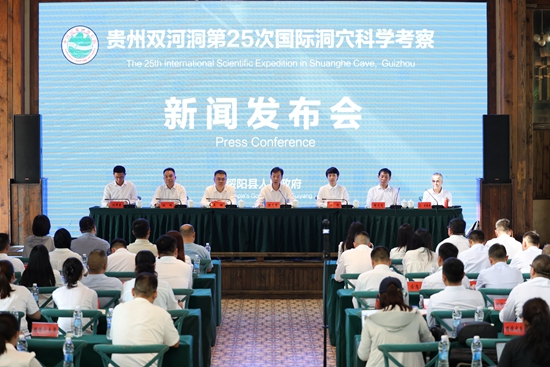
Press conference site
Photo provided by Suiyang County Integrated Media Center
In this expedition, Chinese and foreign cave expedition experts conducted cave exploration, paleontological surveys, and chronological sample testing, updating the connected length, number of cave entrances, and extent of the Shuanghe Cave System. This further clarified the resource inventory of the Shuanghe Cave area and accumulated detailed data for research on cave and karst development and evolution in northern Guizhou, paleontological evolution and paleoenvironmental changes, and cave sediments and paleoclimate changes.
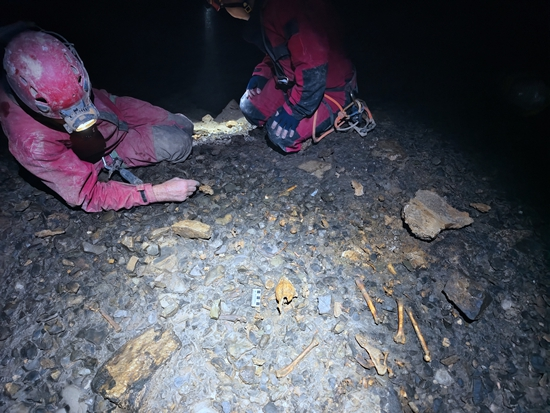
Expedition team conducting investigation inside the cave
Photo provided by Suiyang County Integrated Media Center
The latest expedition data shows that the total length of the Shuanghe Cave System has now reached 481.5 kilometers, with the cave's depth remaining at 912 meters. The system is connected through 124 cave entrances, an increase of 41.8 kilometers and 9 new entrances compared with the 24th International Expedition, achieving a leapfrog breakthrough. There are 436 entrances to unconnected caves, with a total length of 165 kilometers, and the number of entrances has increased by 25, representing potential for further expansion of the Shuanghe Cave System. According to the latest ranking, Shuanghe Cave remains the world's third-longest and Asia's longest cave, while its depth remains the third deepest in China.
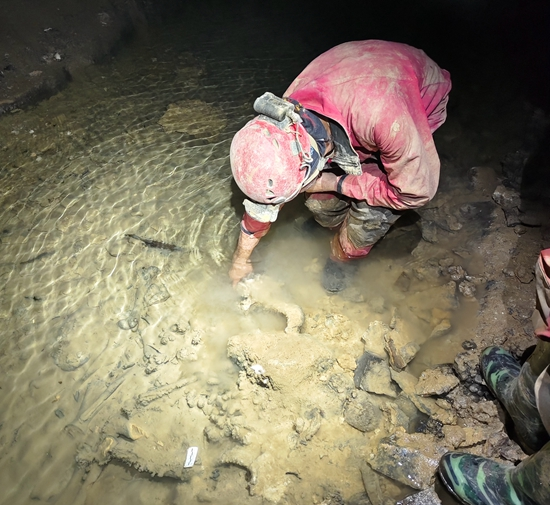
Expedition team conducting investigation inside the cave
Photo provided by Suiyang County Integrated Media Center
This expedition also made breakthrough progress in paleontological surveys, with the addition of 9 giant panda individuals, 1 takin individual, 1 rhinoceros individual, and 1 stegodon individual. In addition, one giant tapir skeleton and one clouded leopard skeleton were newly discovered, and two giant panda scratch marks were found in the cave. Among them, the giant tapir is a juvenile individual with complete skeletal remains, making it one of the most completely preserved specimens of its kind in China. The first discovery of giant tapir and clouded leopard remains in the Shuanghe Karst Cave Group further enriches the regional paleontological species records and provides new samples for studying the distribution of local paleontological populations and species evolution. Up to now, a total of 61 giant panda individuals have been discovered.
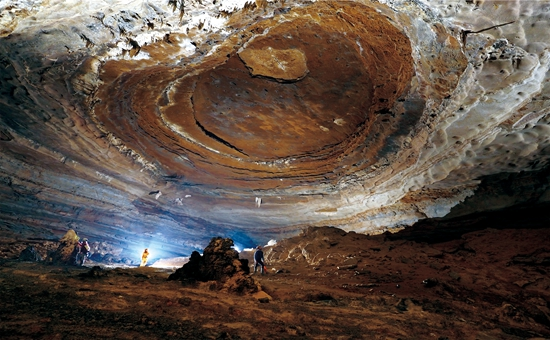
Shuanghe Cave
Photo provided by Suiyang County Integrated Media Center


Copyright ©1997- by CRI Online All rights reserved
