
beijing
On October 26, the 2026 Guangxi media tour along the New International Land-Sea Trade Corridor was launched in Nanning. The event brought together a press delegation comprising Guangxi-based correspondents from selected central media organizations, journalists from media outlets in Guangxi, Yunnan, Guizhou, Sichuan, Chongqing and China’s Hong Kong Special Administrative Region, and journalists from mainstream Vietnamese media outlets. The group will visit Nanning, Qinzhou, Fangchenggang, Baise and other locations for field research and interviews. They will witness Guangxi’s achievements in developing the New International Land-Sea Trade Corridor to a high standard and document, from an international perspective, how Guangxi supports and integrates into the new pattern of opening-up featuring connectivity across land and sea and between China and the rest of the world, as well as mutual support between China’s eastern and western regions.
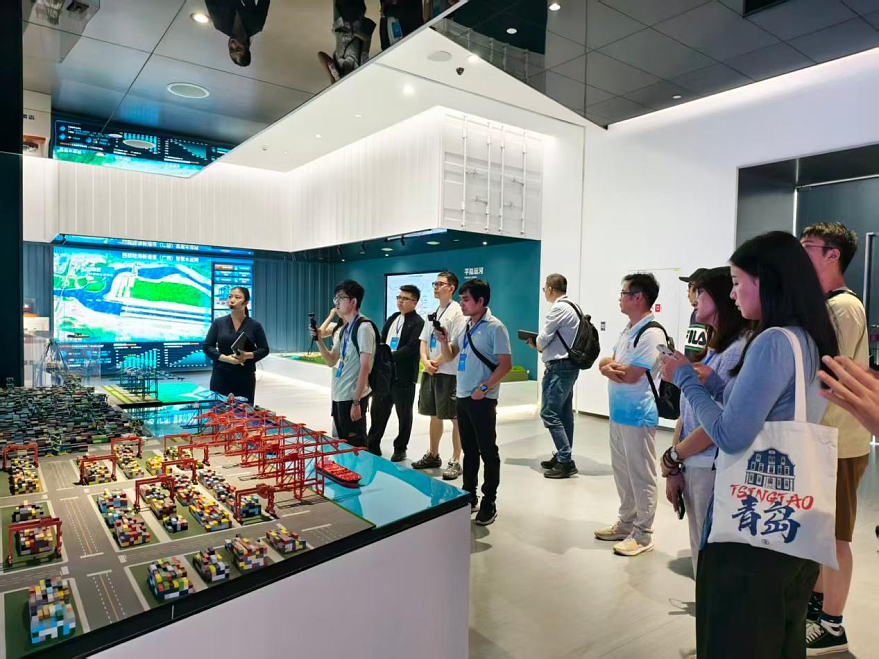
The press delegation visits the Beibu Gulf Port exhibition hall for the New International Land-Sea Trade Corridor. Photo by Cai Juncong
The press delegation’s first stop was the Beibu Gulf Port exhibition hall for the New International Land-Sea Trade Corridor. Located at the junction of the South China, Southwest China and ASEAN economic circles, Beibu Gulf Port boasts a vast hinterland including Chongqing, Yunnan and Guizhou to its north, with Guangdong, Hong Kong and Macao to its east. It serves as the most convenient land-sea connection hub linking Southwest China and ASEAN countries.
Compared with other coastal ports in China, Beibu Gulf Port has three distinctive strengths. First, it sits closer to ASEAN nations, with a concentration of shipping routes serving ASEAN and solid foundations for cooperation. Second, it is close to China’s southwestern hinterland, enabling shorter and more direct overland transport for cargo from Yunnan, Guizhou, Sichuan and Chongqing heading south for export. Third, the development of its multimodal transport system is accelerating. At Qinzhou Automated Container Terminal, containers can be transferred seamlessly between trains and vessels. With the Pinglu Canal open to trial navigation, the direct waterway link connecting the Xijiang River, the Pinglu Canal and Beibu Gulf Port further improves the multimodal cargo collection and distribution system.
Solid statistics demonstrate the progress of corridor development. From 2017 to 2025, the container throughput of Beibu Gulf Port surged from 2.28 million twenty-foot equivalent units (TEUs) to over 10 million TEUs, with an average annual growth rate exceeding 20%. Both its cargo throughput and container throughput place it in the top tier of major coastal ports nationwide. The annual number of rail-sea intermodal train trips along the New International Land-Sea Trade Corridor rose from 178 to more than 10,000, with the service network covering 18 provincial-level regions in central and western China, 76 cities and 166 stations.


Copyright ©1997- by CRI Online All rights reserved
