
beijing
On October 27, the media delegation for the ‘Land-Sea Corridor Connecting the World · River-Sea Synergy Opening New Prospects — 2026 New International Land-Sea Trade Corridor Guangxi Tour’ themed event visited the Qinzhou Railway Container Center Station, capturing the bustling operations at this critical hub where cargo moves directly from ship to train and from train to ship.
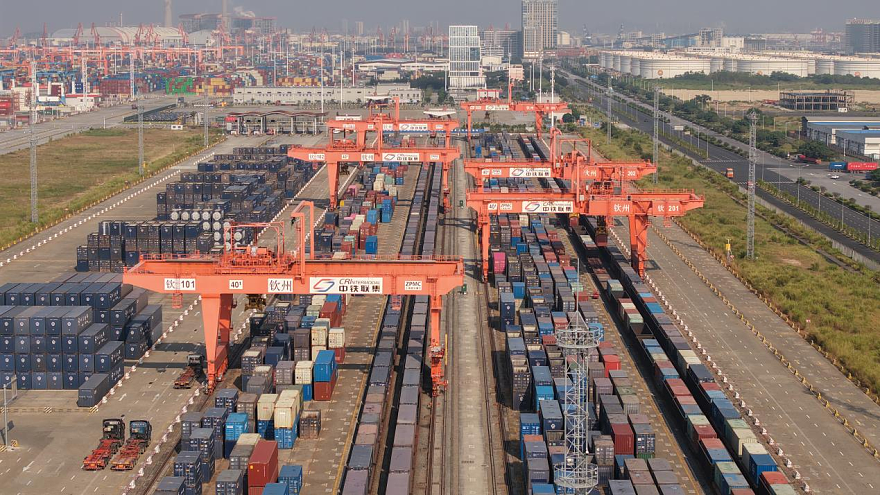
The bustling Qinzhou Railway Container Center Station, photographed by Li Xinming
Phase I of the Qinzhou Railway Container Center Station is located in the Qinzhou Bonded Port Area, covering approximately 1,200 mu. It consists of two operational zones: the port-side zone and the east station zone. The port-side operating zone extends directly to the rear of the Dalanping Automated Terminal at Beibu Gulf Port, enabling seamless connectivity for rail-sea intermodal transport.
Since the station began operating, the number of rail-sea intermodal freight trains handled at the Qinzhou Center Station has increased from 178 in 2017 to over 10,000 in 2025. The number of scheduled train paths has increased from 33 to 52, with services reaching 166 stations across 76 cities in 18 provincial-level regions nationwide, while the number of cargo categories handled has grown from over 640 to more than 1,300.
Since the start of this year, the Qinzhou Railway Container Center Station has strengthened monitoring of key operational metrics, including the proportion of trains carrying loaded containers in both directions and terminal dwell time. It has focused on organizing inter-station freight trains to and from Chongqing, Chengdu and Kunming, giving them priority in freight wagon allocation. At present, outbound cargo from southwestern China via the corridor is evolving from a structure dominated by bulk cargo to a two-way flow pattern in which industrial products move toward the coast, while industrial and mining raw materials are transported inland. From January to September this year, trains from Chongqing to Qinzhou Port carried 120,000 twenty-foot equivalent units (TEUs), marking a 32.6% year-on-year increase, with outbound shipments of industrial goods such as auto parts and tires jumping 95%. Trains transporting industrial raw materials from Qinzhou Port to Chongqing carried 75,000 TEUs, up 16.5% year-on-year, with shipment volumes of quartz sand, zinc concentrate and similar commodities increasing by nearly 300%.
With the Pinglu Canal now open to navigation, southwestern China has formed two parallel cargo access routes to the sea, one via direct rail transport to Qinzhou and the other via Liujing and the Pinglu Canal. Moving forward, the Qinzhou Railway Container Center Station will be positioned as the operational hub for long-haul rail-sea intermodal services with fast transit times along the New International Land-Sea Trade Corridor, functioning as both a dedicated express freight corridor and a contingency logistics corridor. This will create a complementary operational framework where time-sensitive cargo travels by rail, while non-urgent cargo moves via the canal. The setup will not only elevate the overall service capacity of the New International Land-Sea Trade Corridor but also provide more flexible, cost-effective options for southwestern China to integrate into global supply chains. (Text by Cai Juncong)


Copyright ©1997- by CRI Online All rights reserved
