
beijing
On November 5, the second session of the 2026 World Internet Conference Global Elite Training—Future Digital Leadership Development Workshop, hosted by the WIC Digital & AI Academy, concluded in Wuzhen, Zhejiang Province. Over the four-day program, government officials, industry leaders and professionals from nearly 30 countries and regions exchanged views on topics including AI governance and open source, digital transformation, and security governance capacity building. They also attended key events of the Wuzhen Summit and went on field study visits to enterprises such as Alibaba Cloud and Unitree.
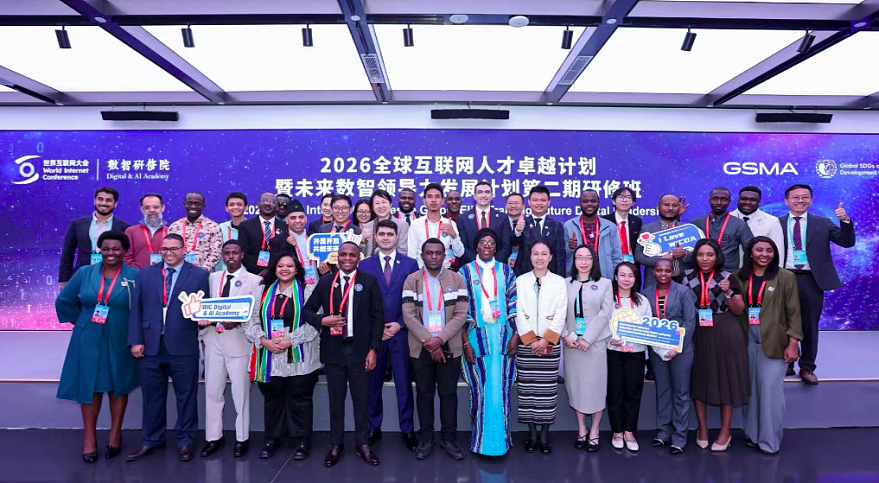
Group photo of participants and staff
As AI technology iterates at an accelerating pace and injects new momentum into the global economy and society, a series of practical challenges have emerged as questions the international community must address together: how to balance openness and security, how to bridge the digital divide, how to define rights and responsibilities related to AI, and how to adapt technology to each country's national conditions. A number of industry experts who taught in the program shared their distinctive insights on global digital-intelligence development, drawing on their own research and industry practice.
The widespread adoption of open-source AI has amplified the value of technology flows, while security risks have become increasingly prominent, making the trade-off between openness and security an unavoidable practical issue. John Hoffman, Chairman and Director of GSMA Ltd, noted that openness and security are not an "either-or" choice; rather, a dynamic balance must be sought amid constant tension. He said countries need to, on the basis of consensus on rules, uphold inclusiveness and universal benefit, keep working to resolve the practical tensions between openness and security, put in place necessary security "guardrails," respect each country's digital sovereignty, and promote multilateral collaboration so that digital-intelligence technologies truly benefit the whole world.
Global AI governance is markedly fragmented, with substantial differences in systems and standards across countries, and open-source collaboration is regarded as an important pathway to breaking the governance deadlock. Fu Hongyu, Director of the AI Governance Center at Alibaba Research Institute and a member of the Data Governance Working Group of the United Nations Commission on Science and Technology for Development (CSTD), said in an interview that open source enables cooperation in the AI field, and such cooperation is the foundation for building global governance, providing the "greatest common denominator" for future international governance.
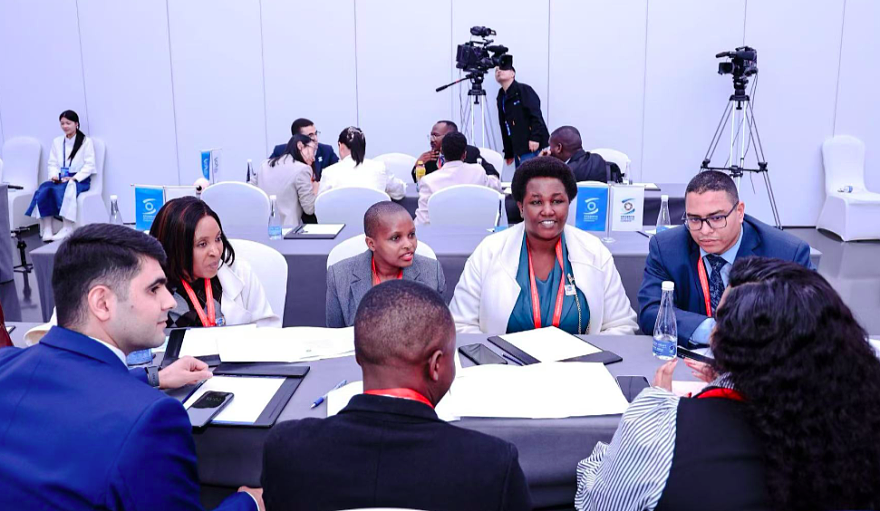
Participants in a group discussion
The dividends of AI technology are not distributed evenly, and developing countries, constrained by shortcomings in both software and hardware, generally face a catch-up dilemma. Zhao Quan, Senior Programme Manager for Trade and Investment Policy at the International Trade Centre (ITC), observed in a lecture that many developing countries feel varying degrees of anxiety in the face of rapid AI development. The program provides a valuable exchange platform for participants from all countries, helping developing countries grasp global AI development trends and explore development paths in light of their own national realities. China's commitment to open source also offers new pathways and opportunities for developing countries to overcome their AI development challenges.
Digital-intelligence capacity building cannot focus solely on hardware technology; governance and literacy at the "soft" level are equally decisive for the ultimate effectiveness of technology deployment. Zeng Yi, Chair‑member of the Artificial Intelligence Special Committee of the WIC and Wu Yuzhang Chair Professor at the Gaoling School of Artificial Intelligence, Renmin University of China, pointed out in an interview that AI capacity building is not only about infrastructure for data, algorithms and computing power; more importantly, it is about improving public literacy and security governance capacity. The Digital & AI Academy is both an education platform and an exchange platform, where countries share their needs, understandings and visions. Drawing on multi-party technologies, it helps developing countries tackle sustainable development challenges and ensures that technology truly serves the development of all countries.
In the era of digital globalization, connectivity is an important prerequisite for addressing the digital divide. Francis Gurry, Vice-Chair of the World Internet Conference and Chairman of the Executive Council of the Global SDGs and Leadership Development Center (GSLDC), stressed that cross-border connectivity is essential to prevent the digital divide from widening. In a deeply connected globalized world, only by upholding collaboration and mutual assistance can we close the digital gap and bring the dividends of digital intelligence to all parts of the world.
Participants from countries around the world, drawing on the current state of digital development in their home countries, brought observations and reflections from the perspective of developing countries. Mitchell Mubariki, a national prosecutor from Zimbabwe, said that for developing countries to advance the deployment of AI, they need to formulate policies adapted to local realities and clarify who bears the risk in AI application scenarios, so as to better translate technology into a driving force for national development. Participants noted that the program brought together experts and peers from many countries and offered a wealth of practical cases and intellectual exchanges, helping them see clearly the broader trend of global digital-intelligence development while taking home actionable ideas for their own countries.


Copyright ©1997- by CRI Online All rights reserved
