
beijing
On November 11, an inception meeting was held at Guizhou Minzu University for two major projects in the special cultural research category of the Guizhou Provincial Philosophy and Social Sciences Planning Program. One project, Research on the Archaeological Cultural Heritage System of the Guizhou Plateau and Mountainous Areas and the Integration of Regional Cultural Systems within Chinese Civilization from the Perspective of Diversity in Unity, is led by Prof. Lü Guofu, Party secretary of Guizhou Minzu University. The other, Research on the Systematic Cataloging, Value Assessment, Intellectual Property (IP) Development, and Development across the Entire Industry Chain of Guizhou’s Ethnic Cultural Resources, is led by Prof. Wu Yiwen, president and deputy Party secretary of Guizhou Minzu University.
Prof. Lü Guofu reported on the archaeological relics and remains in the Guizhou plateau and mountainous areas, the mountain cultural heritage system, the mountain civilization system, and their important value within Chinese civilization. The project consists of 10 sub-projects, forming a research chain from the macro to the micro, from theory to empirical research, and from prehistoric times to the Ming and Qing dynasties. The research team will carry out work focusing on systematically constructing the cultural heritage system of the Guizhou plateau and mountainous areas, conducting in-depth research on the transformation mechanisms of mountain civilization, exploring the concrete ways in which diversity in unity is realized in Guizhou, and clarifying the subjectivity and contributions of mountain civilization.
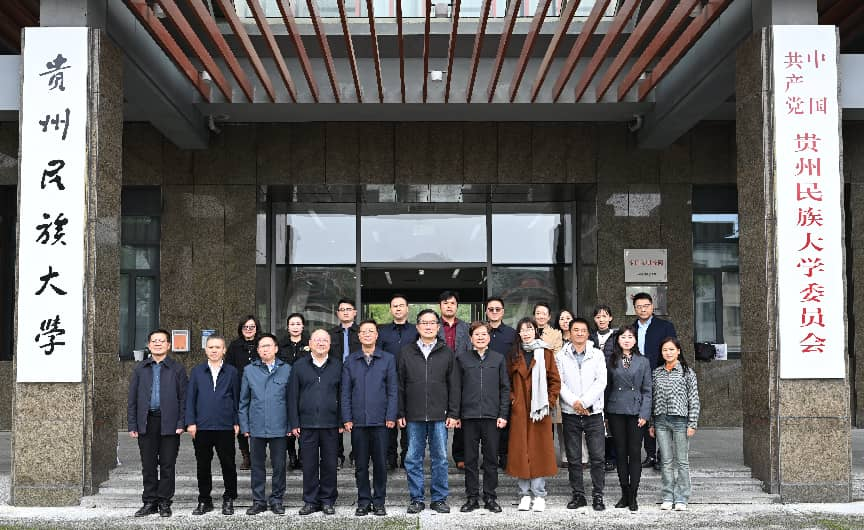
Group photo of the research teams. Photo courtesy of Guizhou Minzu University
Prof. Wu Yiwen gave a thorough introduction to the project by grounding it in the pattern of diversity in unity of Chinese civilization and closely aligning it with the national cultural development strategy. In response to practical problems such as relatively slow progress in assessing the value of Guizhou’s ethnic cultural resources, the need to deepen academic research, and barriers to commercializing these resources, the project centers on the development of a theoretical system and methodology. It strives to resolve the structural contradictions of “an unclear resource base, ambiguous value, inefficient commercialization, and a fragmented industry,” advance the development of an independent knowledge system for Qian studies (the study of Guizhou), and provide a Guizhou solution for proactively integrating into the broader framework of cultural heritage protection.
Group photo of the research teams. Photo courtesy of Guizhou Minzu University
The expert panel spoke highly of the significance of the two projects’ research topics and their overall design. One project focuses on the grand narrative of the integration of southwestern mountain civilization into the diverse and unified Chinese civilization, while the other comprehensively explores the mechanisms and pathways for transforming Guizhou from a province rich in ethnic cultural resources into one with a strong ethnic cultural industry.


Copyright ©1997- by CRI Online All rights reserved
