
beijing
In Chaozhou, Guangdong Province, bamboo is taking on a new mission. Although not traditionally rich in bamboo resources, the city has leveraged technological innovation and industrial integration to develop a full-fledged bamboo industry chain covering R&D, standard-setting, product application, and cultural integration, all under the national "bamboo as a substitute for plastic" strategy.
Plastic pollution is a global challenge. In 2023, China's National Development and Reform Commission and other agencies issued a three-year action plan to accelerate the substitution of plastic with bamboo. Guangdong Province has since introduced multiple policies to support bamboo industry innovation and the province's "Green and Beautiful Guangdong" initiative.
Chaozhou has a long history of bamboo culture, from bamboo-woven plaster walls in Song-dynasty architecture to everyday bamboo utensils. The city government has adopted a strategy of "revitalizing agriculture, substituting plastic, and boosting tourism with bamboo," focusing on technology, industrial chain development, and brand building, while promoting the integration of primary, secondary, and tertiary industries.
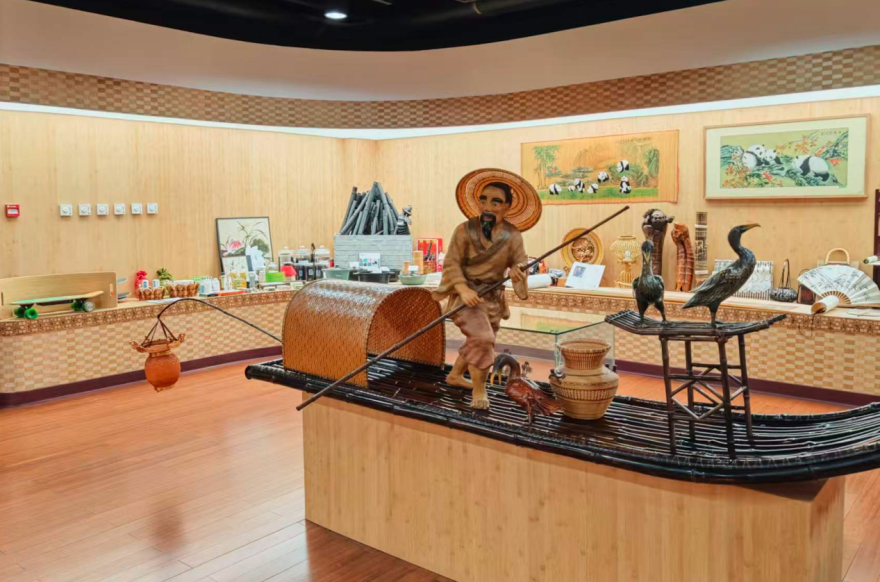
International Bamboo and Rattan Centre exhibition hall
Photo by Ding Mei, Wu Yuhang
Bamboo is prone to decay, insect infestation and mould, which long limited its outdoor and industrial use. Guangdong Jianzhong New Bamboo Material Technology Co., Ltd. (Jianzhong), a leading local enterprise, has developed a "baking" process inspired by ancient bamboo-slip preservation techniques.
Tests show that the treated bamboo achieves strong corrosion resistance, level-9 termite resistance and B2 flame retardancy. No 235 targeted chemical substances were detected, meeting EU RoHS 2.0 export standards–paving the way for international market access.
Jianzhong has focused on developing a bamboo-woven geogrid, a 100% bamboo-based alternative to plastic geogrids used in geotechnical engineering. The product is suitable for highways, railways, airports, slope protection, agricultural facilities and the "Three Norths" shelterbelt project.
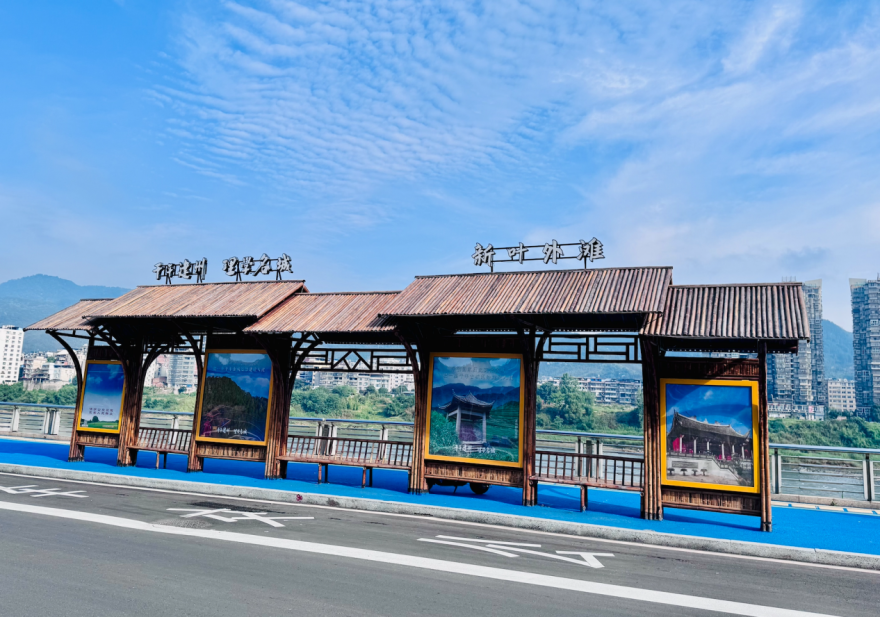
A bus stop made of baked bamboo material in Jian'ou, Nanping, Fujian Province
Photo courtesy of Jianzhong
In 2021, Jianzhong led the drafting of a national standard for bamboo-woven geogrids, which passed review in 2024. In 2026, the recommended national standard GB/T 47052-2026 was officially released and will take effect in August 2026. The company also participated in formulating the Guangdong provincial standard “Technical specification for the application of carbonised composite bamboo-woven geogrids”. To date, Jianzhong holds more than ten national patents, and its products have been used in rural revitalisation projects in Guangzhou, Qingyuan, Xinyang (Henan) and other regions.
In 2024, Jianzhong was recognised as a provincial-level leading forestry enterprise and was invited to share its experience at a national training session on bamboo as a plastic substitute.
Chaozhou emphasises the integration of bamboo culture with industry. Jianzhong has built a bamboo eco-industrial park and a bamboo architecture study base, developing a “bamboo + culture + tourism + education” model. The city also promotes bamboo weaving techniques and develops cultural products such as bamboo lanterns and ornaments, creating jobs and increasing incomes.

A symposium on the application of bamboo-woven geogrids.
Photo by Ding Mei, Wu Yuhang
In urban construction, Chaozhou uses bamboo-based materials such as bamboo-woven geogrids for municipal, transport and water conservancy projects, exploring a closed loop of "resources–production–recycling–reuse".
Looking ahead, Chaozhou plans to further integrate standards, production and application, aiming for breakthroughs in construction, bamboo architecture and bamboo products. The city will build a comprehensive service platform for technology transfer, talent training and supply-demand matching, accelerate research on bamboo modification and process optimisation, and scale up the market application of new products and techniques. Its goal is to become an innovation hub for China's bamboo industry, turning "small bamboo" into a "big industry" that drives rural revitalisation and green development. (Text by Zhu Xiao, Wu Yuhang, Ding Mei)

![[Flavors of China: Summer Burst] Cherries Ripen in Chengcheng County_fororder_9361e61f97ed89a5a08bab09adf24a3c(1)](http://v2.cri.cn/cb5a6d96-d0c4-4fd0-a895-b6135667d84a/image/00f73cf2feb54348afbe5d3340f7c3b7.1000x563.636x358.jpg)


Copyright ©1997- by CRI Online All rights reserved
