
beijing
Video by Zhong Luxuan
On May 16, the first phase of the Astana Light Rail Project in Kazakhstan, mainly constructed by China Construction Sixth Engineering Bureau, or CSCEC 6th Bureau, officially began operation. As Central Asia’s first urban light rail system and the region’s first fully automated driverless smart rail transit line, the entire line was built with Chinese technology, standards, and equipment, marking an important achievement of China-Kazakhstan cooperation under the Belt and Road Initiative.
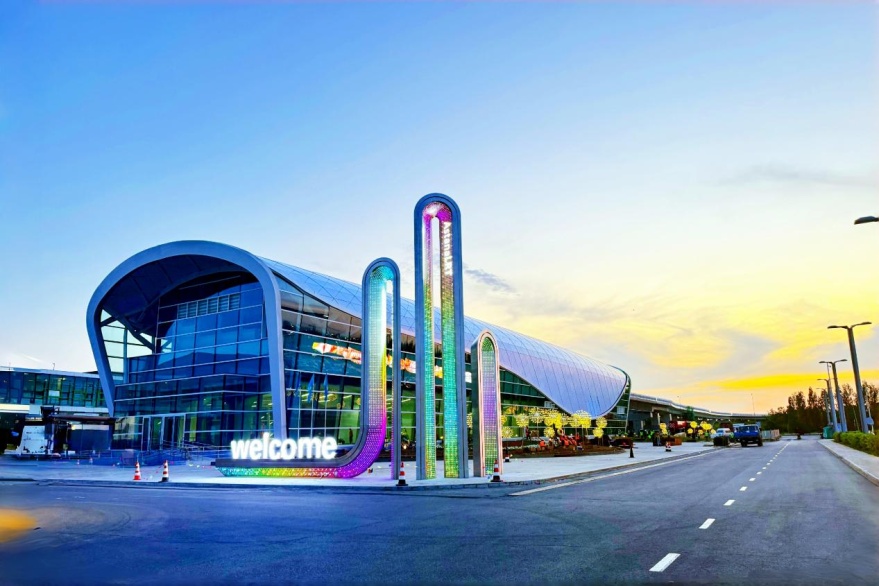
Station Exterior
The Astana Light Rail Project has a total length of about 22.4 kilometers, of which 18.34 kilometers were undertaken by CSCEC 6th Bureau, including 14 stations, 15 track sections, and one depot. Starting from Nursultan Nazarbayev International Airport in the south and ending at the new railway station in the north, the line connects landmark buildings and key functional areas such as the international airport, Nazarbayev University, Expo Park, the Astana Grand Mosque, Abu Dhabi Square, the Ministry of Defense, the Presidential Palace, the National Information Technology Center, the Central Concert Hall, the National Museum, and the new railway station.
Astana, the capital of Kazakhstan, is the birthplace of the Silk Road Economic Belt initiative. The opening of the Astana light rail has set a new benchmark for bilateral practical cooperation between China and Kazakhstan in various fields, especially in major transport infrastructure.
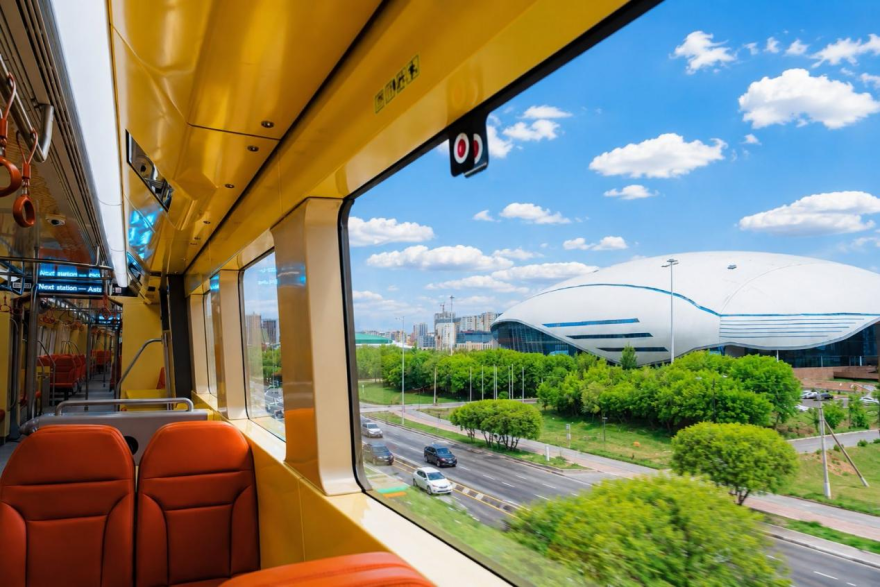
Scenery Along the Line
Known as the world’s second-coldest capital city, Astana has frigid winters, with temperatures dropping as low as -40°C, leaving less than six months of effective construction time each year. Multiple challenges, including extreme cold, a short construction window, and complex geological conditions, posed severe difficulties for the light rail project.
“Extreme cold imposes higher requirements on construction materials, techniques, and equipment for light rail construction. We optimized the construction plan, improved winter construction support measures, and strictly controlled concrete curing and construction procedures under low-temperature conditions, successfully overcoming the difficulties of rail transit construction in cold regions,” said Ji Chenglong, Executive Manager of the Astana Light Rail Project of CSCEC 6th Bureau. “Meanwhile, green and smart construction methods such as Building Information Modeling (BIM) technology, intelligent welding robots, and prefabricated construction were adopted in the construction of light rail bridges, stations, and track sections, greatly improving construction quality and efficiency.”
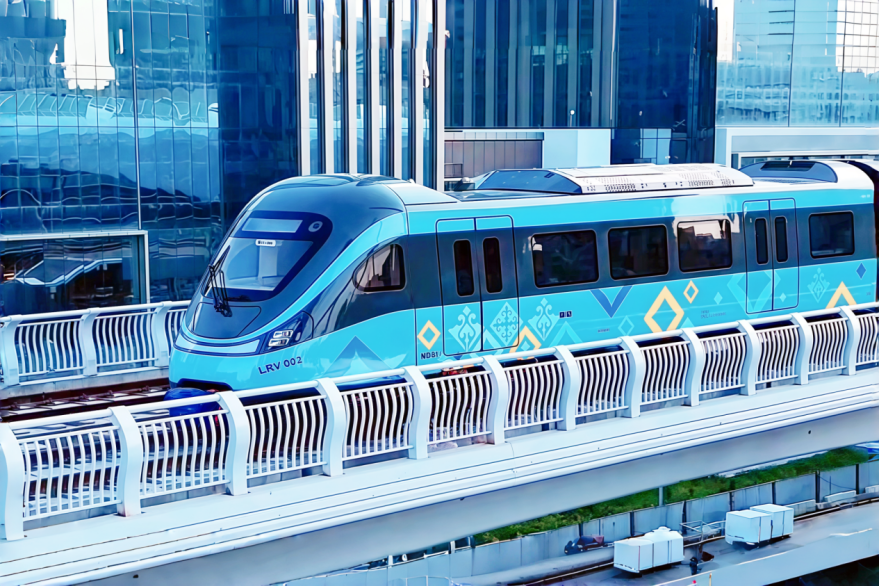
Train Exterior
During the project’s construction, CSCEC 6th Bureau actively fulfilled its corporate social responsibility by employing local residents, providing more than 2,000 jobs, and holding over 100 technical training sessions. It cultivated a group of local rail transit professionals well versed in technology and standards, helping drive local industrial upgrading. In addition, it carried out cultural exchanges and university-enterprise cooperation locally, launching joint programs with local universities and research institutions in technological research, talent development, and cultural exchange.
A representative of City Transportation Systems LLC of Kazakhstan, the project owner, said that the Astana light rail is a key project for improving urban public transport. It is vital for optimizing the urban layout, facilitating residents’ travel, and supporting sustainable urban development. The Chinese construction team maintained strict control over project quality and efficiency, and applied mature and reliable urban light rail construction technologies, laying a solid foundation for the project to be completed and put into operation to a high standard, with high quality and efficiency.
The official operation of the Astana light rail has further improved the city’s public transport system and connected the north-south transport corridor of the city. During rush hours, the commute time between the two ends of the line has been shortened from 60 minutes to 28 minutes compared with travel by private car.
Integrating key technologies such as fully automated driverless operation, third-rail power supply, and adaptation to extreme cold, the line has become one of the most technologically representative urban rail transit projects in Kazakhstan and Central Asia as a whole. It also serves as an exemplary project for the systematic internationalization of China’s urban light rail construction capabilities. The project has promoted the upgrading of local transport infrastructure, greatly improved residents’ travel efficiency, energized urban development, and boosted high-quality economic and social growth.
As a landmark project under China-Kazakhstan Belt and Road cooperation, the Astana light rail is not only a product of technology and engineering, but also a model of people-to-people bonds and win-win cooperation. During construction, the Chinese contractor carried out cooperation with local higher education institutions, including Nazarbayev University and Eurasian University, in academic research, talent development, cultural exchange, and mutual learning. The project also provided transport support for major events such as the SCO Summit and the Central Asia Summit. Its outstanding performance in project implementation has won recognition from the Chinese Embassy in Kazakhstan, the Kazakh government, the project owner, and other relevant parties.


Copyright ©1997- by CRI Online All rights reserved
