
beijing
On May 25, the 500 kV substation in Linping District, Hangzhou, was successfully completed and put into operation. It is the first newly commissioned 500 kV power transmission and transformation project in Zhejiang during the 15th Five-Year Plan period, providing strong support for summer peak electricity supply and economic development in the province this year.
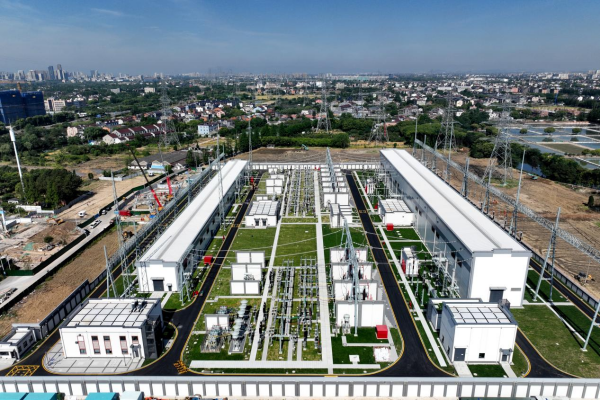
The newly commissioned 500 kV Linping Substation serves as a key supporting facility for China's West-to-East Electricity Transmission Strategy in Zhejiang and functions as a regional power hub. The project includes the construction of three 1,000 MVA main transformers, with a total investment of about 668 million yuan. It can add 2.4 million kilowatts of power supply capacity to northeastern Hangzhou each year, efficiently absorb clean electricity transmitted from the Baihetan Hydropower Station to Zhejiang, and help the province reduce carbon emissions by over 8.5 million tons annually. The project significantly enhances the capacity and reliability of the regional power grid and supports industrial development centered on the Grand Canal Science and Innovation City in Linping District.
On one hand, Linping District is accelerating the development of emerging industries such as life and health, intelligent equipment, and digital culture, driving strong demand from enterprises for reliable electricity supply. On the other hand, the project must complete the installation of GIS equipment—which requires extremely high environmental cleanliness standards—within a tight construction schedule. Faced with these dual pressures, the construction team had to apply advanced technologies and refined management practices.
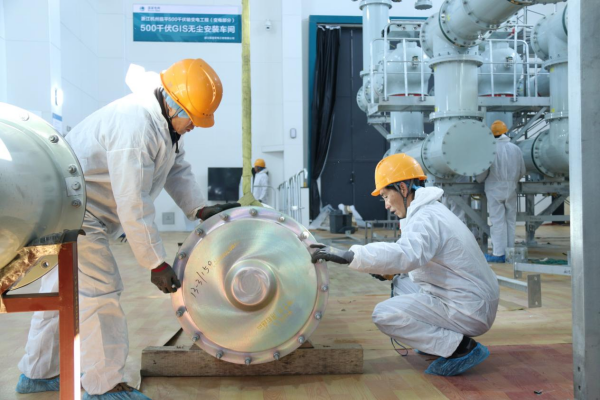
"The installation quality of GIS equipment directly bears on the long-term operational safety of substations. The equipment demands extremely high cleanliness of the installation environment, and even tiny dust particles or impurities may pose potential safety hazards during operation," recalled Mao Kaiping, construction project manager of State Grid Zhejiang Electric Power.
"The installation quality of GIS equipment is directly linked to the long-term operational safety of substations. The equipment requires an extremely clean installation environment, and even the slightest dust or impurities may pose safety risks during operation," recalled Mao Kaiping, construction project manager of the State Grid Zhejiang Electric Power.
To ensure installation quality of GIS equipment, the team implemented full-process dust control measures, including dust reduction, removal, isolation, blocking, and containment. Equipped with air shower rooms, air purification systems, dehumidifiers, and environmental monitoring devices, the site achieved highly refined environmental control. In addition, customized dust-proof enclosures and mobile clean tents were deployed. Specialized dust-free installation schemes were developed for key components such as outdoor branch busbars and bushings. The entire installation process—including casing opening and flange assembly—was fully video-recorded for traceability, eliminating potential safety risks at the source.
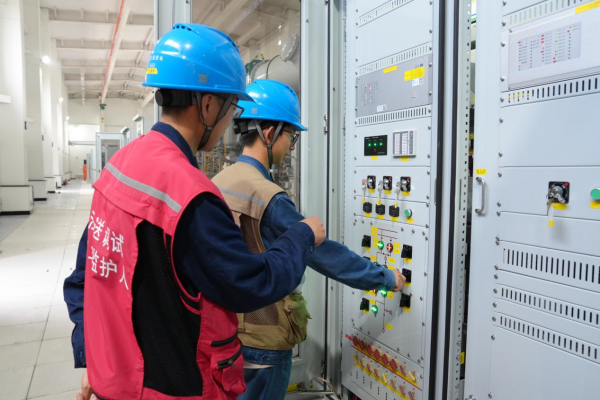
Technological breakthroughs were also achieved during the commissioning phase. The project team independently developed a simulated load test system, which was applied for the first time in this newly built 500 kV substation. Using a three-phase primary current and voltage injection test device, current and voltage were applied across all transformers and secondary circuits to comprehensively verify wiring accuracy and protection reliability, serving as a "full-system health check" for the power grid.
"Electrical current paths are like river channels. The simulated load test is like using a controlled small water flow to fully check the smoothness of the channel, valve tightness, and flow distribution before formal operation of a newly built waterway, so as to identify risks and eliminate defects in advance," explained Tong Qifeng, head of the commissioning work at Linping Substation. The technology reduces the commissioning time of new substations by about one third, significantly simplifies operational procedures, and reduces dispatching pressure. It also fundamentally avoids a large number of switching operations and grid risks, building a precise and reliable "safety barrier" for stable power system operation.
Zhejiang's peak electricity load is expected to reach 142 million kilowatts this summer, up 11 million kilowatts year on year. In response to the supply-demand situation, State Grid Zhejiang Electric Power is accelerating the construction of major power grid projects. A total of 123 backbone grid projects are scheduled to be commissioned within the year, continuously enhancing the province's power supply capacity and security level.
It is reported that the State Grid Corporation of China has announced that its fixed-asset investment in power grid construction will exceed 4 trillion yuan during the 15th Five-Year Plan period. In 2026, State Grid Zhejiang Electric Power plans to invest over 51 billion yuan in grid fixed assets, representing a year-on-year increase of 6.2 percent. Investment in the first quarter reached 11.118 billion yuan, an increase of more than 60 percent year on year. Over the entire 15th Five-Year Plan period, Zhejiang's power grid investment is expected to increase by 50 percent compared with the 14th Five-Year Plan period.
(Fang Zheng, Luo Zhen)


Copyright ©1997- by CRI Online All rights reserved
