
beijing
A launch meeting for Strategic Research on the Deep Integration of Water Science and Technology Innovation with Water Industry Innovation in the “Lake+” Green Development Zone Around Wanlv Lake, a key advisory research project of the Guangdong Research Institute for China Engineering Science and Technology Development Strategy, was held recently in Heyuan.
More than 20 people attended, including project leader Tang Hongwu, a member of the Chinese Academy of Engineering (CAE) and president of Sun Yat-sen University; CAE members Zhang Jianyun and Guo Renzhong; other academicians and experts; and officials from relevant departments of Guangdong Province and Heyuan.
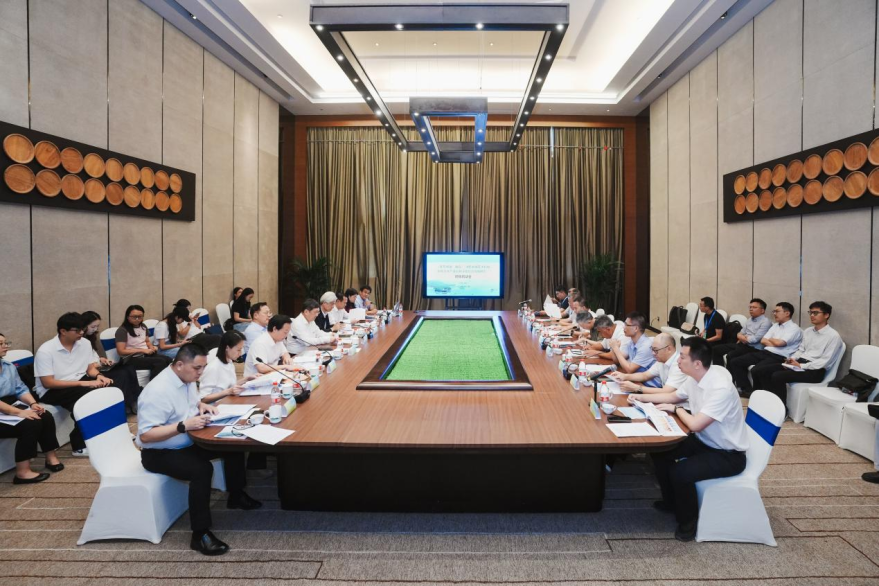
The project launch meeting
Based on the need for ecological conservation and green development around Wanlv Lake, the project aims to address the challenge of coordinating the protection of water resources with industrial development and explore effective pathways for turning advances in water science and technology into water-industry applications.
In its presentation, the project team proposed a coordinated “3R” development model comprising water resources, water R&D, and water applications. The study will systematically examine four areas: innovation in water science and technology, the translation of research results into water-industry applications, the realization of ecological value, and supporting mechanisms. It will ultimately produce plans for major science and technology platforms, a list of key tasks, and policy recommendations tailored to different levels of government.
During the expert discussion, CAE member Wu Qingping, research fellow Jin Wencheng, professors Zhang Yang and Chen Xiaohong, deputy chief economist Xiong Renshu, and other experts offered suggestions.
The experts stressed that the study must closely align with major decisions of the CPC Guangdong Provincial Committee and the Guangdong Provincial Government and must be practical and actionable. They also called for coordination between the protection of Wanlv Lake as a water source and territorial spatial planning.
In particular, they recommended further exploring the health value of Wanlv Lake’s high-quality water resources and their potential for industrial branding, developing a Wanlv Lake-specific system of water health standards, and using technological innovation to increase the brand premium of those resources.
In his closing remarks, Tang said the project team would further strengthen the policy relevance, institutional grounding, and scientific rigor of its strategic advisory work. It would use robust data to make its findings more persuasive and put forward targeted, actionable policy recommendations at the national, provincial, and municipal levels.
The team would also fully incorporate input from experts across disciplines, deepen its thematic studies, and strive to produce high-quality strategic advisory findings with practical value for decision-making.
The project is one of the Guangdong Research Institute’s key annual advisory research projects. Its final results will provide important decision-making support for Heyuan’s efforts to establish a pilot area for realizing the value of ecological products and explore new pathways for integrating scientific and technological innovation with industrial development.
Wanlv Lake is an important source of drinking water for the Guangdong-Hong Kong-Macao Greater Bay Area. Its green development approach could serve as a model for lake-based ecological function zones in Guangdong and across China.
(Text by Fu Yan)


Copyright ©1997- by CRI Online All rights reserved
