
beijing
Recently, technical staff from the Disaster Prevention and Mitigation Center of the State Grid Gansu Electric Power Research Institute successfully completed the pilot planting of prefabricated vegetation in the construction-disturbed area of the Shuiyuan 750 kV Power Transmission and Transformation Project, marking the official transition of the institute's key environmental research project, "Research on Biomimetic Prefabricated Vegetation Restoration Technology Based on Ecological Fertile Islands for Power Grid Projects in Typical Areas of the Hexi Corridor, Gansu," to the on-site application stage.
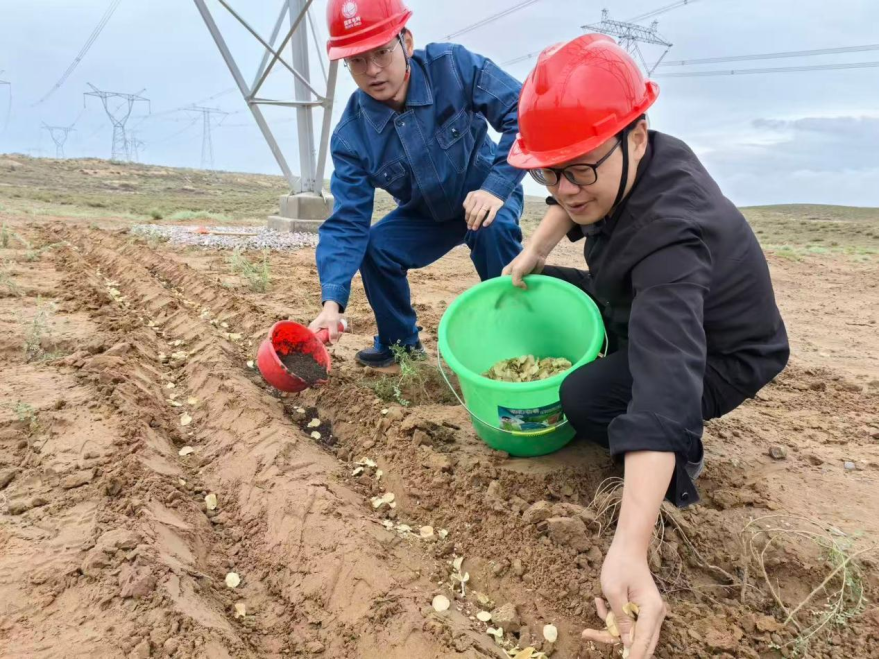
Technical staff from the State Grid Gansu Electric Power Research Institute conduct a field pilot application of the ecological fertile island-based vegetation restoration technology at the Shuiyuan 750 kV Power Transmission and Transformation Project
Photo by Liu Yang
The ecological fertile island-based vegetation restoration technology applied in this project is a tailored biomimetic restoration solution developed by the institute for the ecological conditions of the Hexi Corridor. The research team conducted in-depth studies on the formation of ecological fertile islands in desert environments, as well as their mechanisms for water and soil conservation and vegetation growth. Drawing on biomimetic principles, the team investigated the ecological niches of plant communities on natural ecological fertile islands together with the mechanisms governing nutrient transport and cycling. The researchers also identified the interactions among plant communities, microbial communities and soil components within these ecosystems, developed vegetation configuration schemes for artificial fertile islands, and established nutrient self-sustaining technologies for fertile island micro-ecosystems. These achievements have overcome several key technical challenges in ecological restoration for arid regions and led to the development of an innovative artificial prefabricated vegetation restoration technology based on the fertile island effect. The technology overcomes many of the inherent limitations of conventional ecological restoration approaches for power grid projects in arid regions. Compared with traditional approaches, it is better suited to the ecological conditions of the Hexi Corridor's "Desert-Gobi-Wasteland" areas, offering significant improvements in restoration adaptability, operational stability and overall restoration performance.
The new technology is currently undergoing pilot application in the Shuiyuan 750 kV Power Transmission and Transformation Project. By taking advantage of the unique benefits of artificial ecological fertile islands in accumulating water and soil, stabilizing sand and conserving soil moisture, the technology effectively improves the micro-ecological environment in areas disturbed by power grid construction. It significantly increases the establishment and survival of xerophytic vegetation, enhances ecological restoration efficiency, and accelerates the recovery of areas ecologically disturbed by construction activities. In addition, the technology delivers lasting benefits in water conservation, soil stabilization and wind and sand erosion control, helping curb desertification along the Hexi power transmission corridor. It provides strong technical support for strengthening the ecological security barrier in the Hexi Corridor while promoting the coordinated, high-quality development of power grid projects and the ecological environment. (By Qi Weijian and Luo Xingru)


Copyright ©1997- by CRI Online All rights reserved
